

Andrea Lelario
Glimmers in the Woods
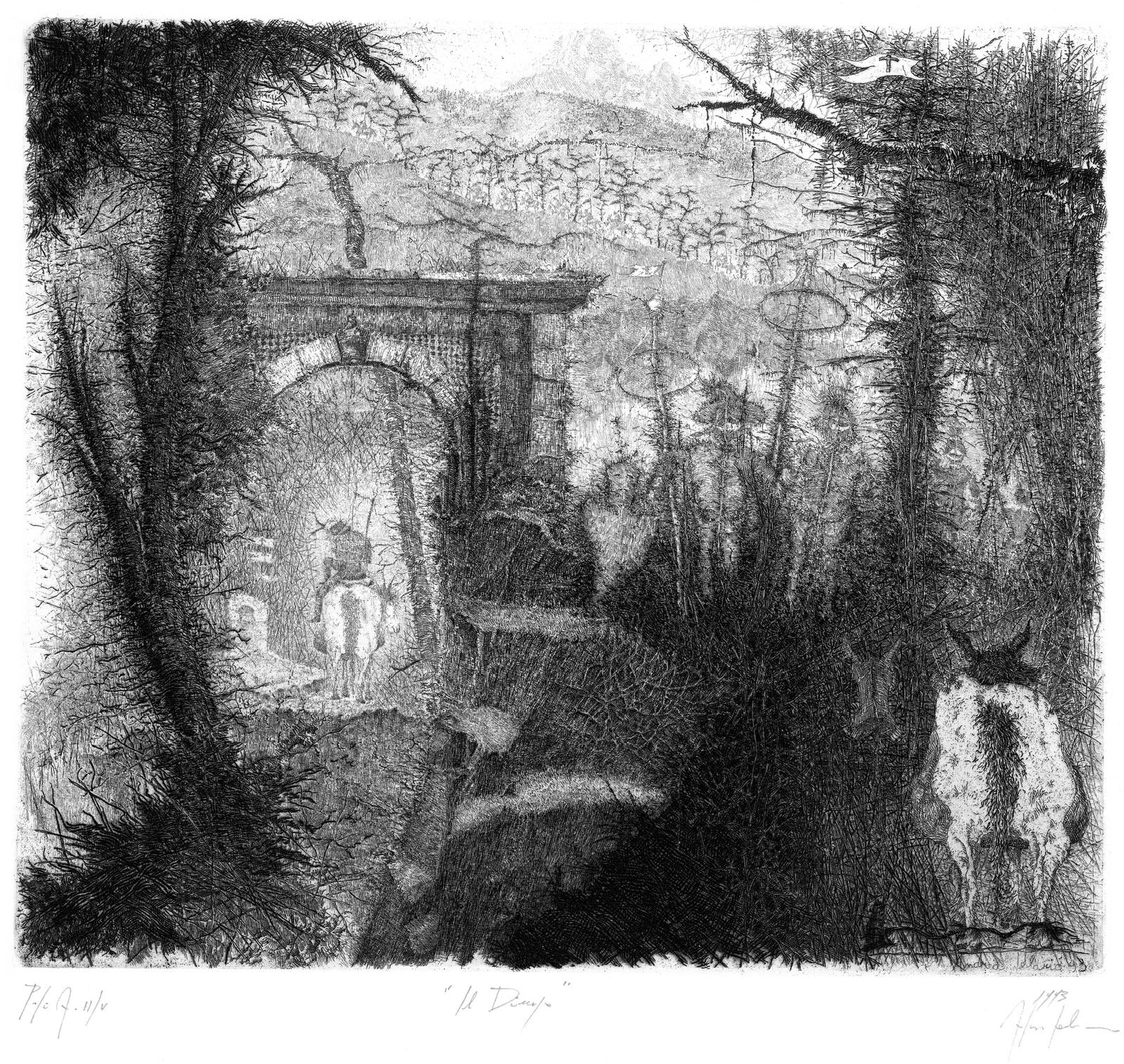
Andrea Lelario entrusts his works to the vehemence of a conflict between the symbolic and rhythmic values of the mark, amidst the ever-lurking impulse to “signify” through metaphors. The repetition of his mark becomes language, reinforcing the concept that something cannot be other than what it is. This attitude, in dialogue with the redundancy of Gertrude Stein, yields a series of meanings associated with it, inviting the viewer to fill the signifying void with their own emotional content.
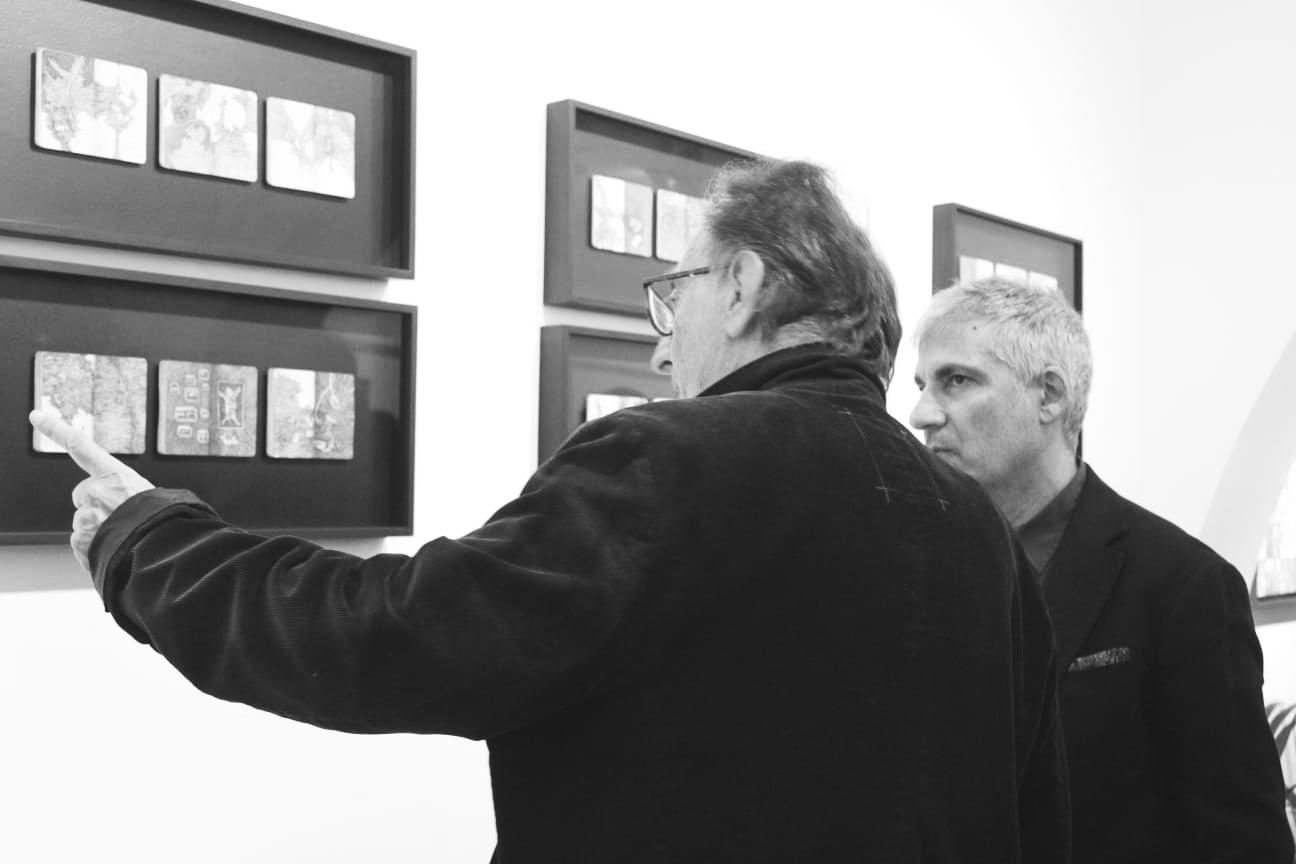
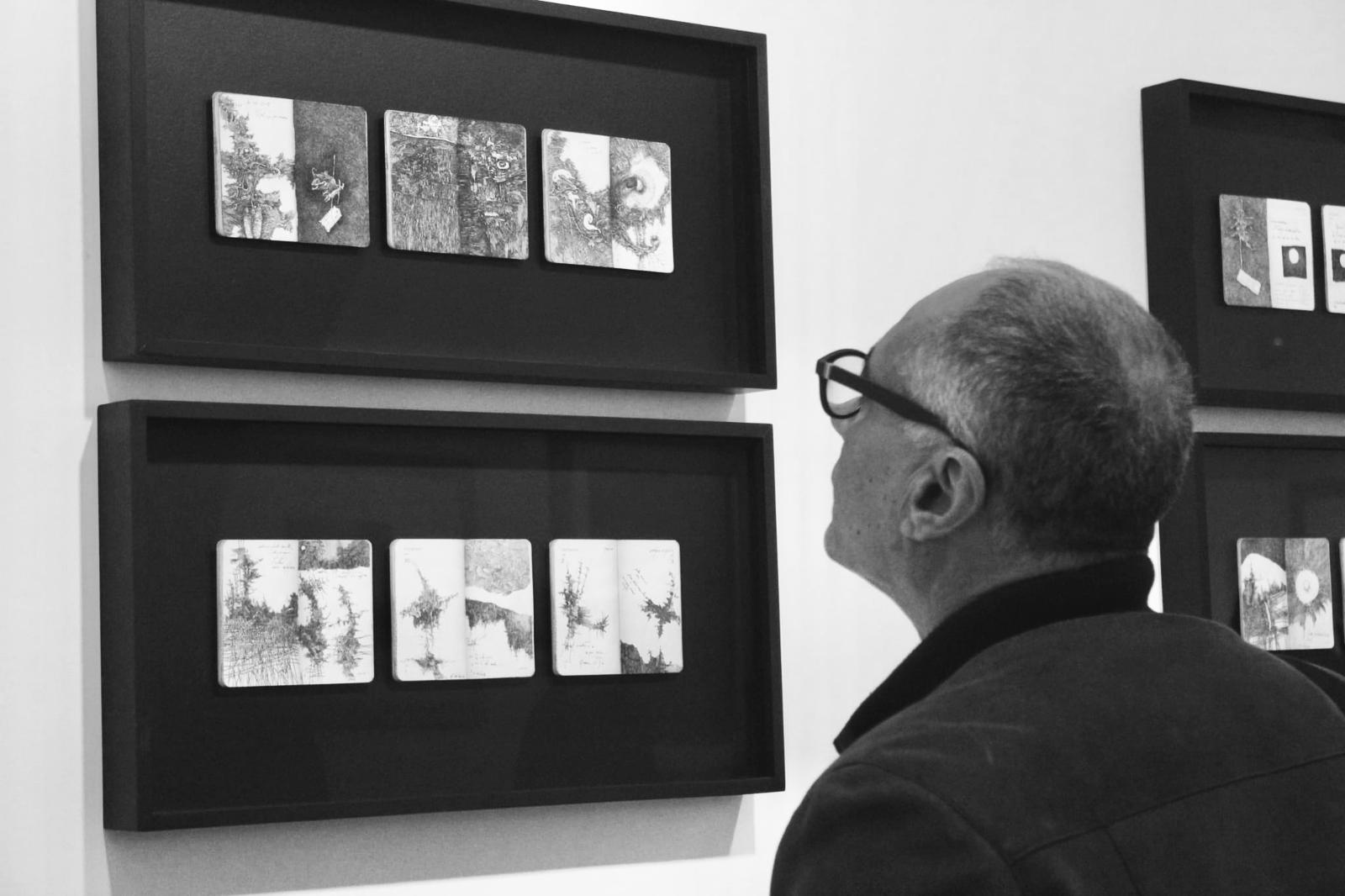
Lelario chooses the notebook as his primary expressive medium, where he transcribes figurative annotations, hermetic in their proportions yet capable of expanding along the edges. He starts with 0.3 micron pen drawings on cardstock, engravings, photoengravings, and oversized graphites.
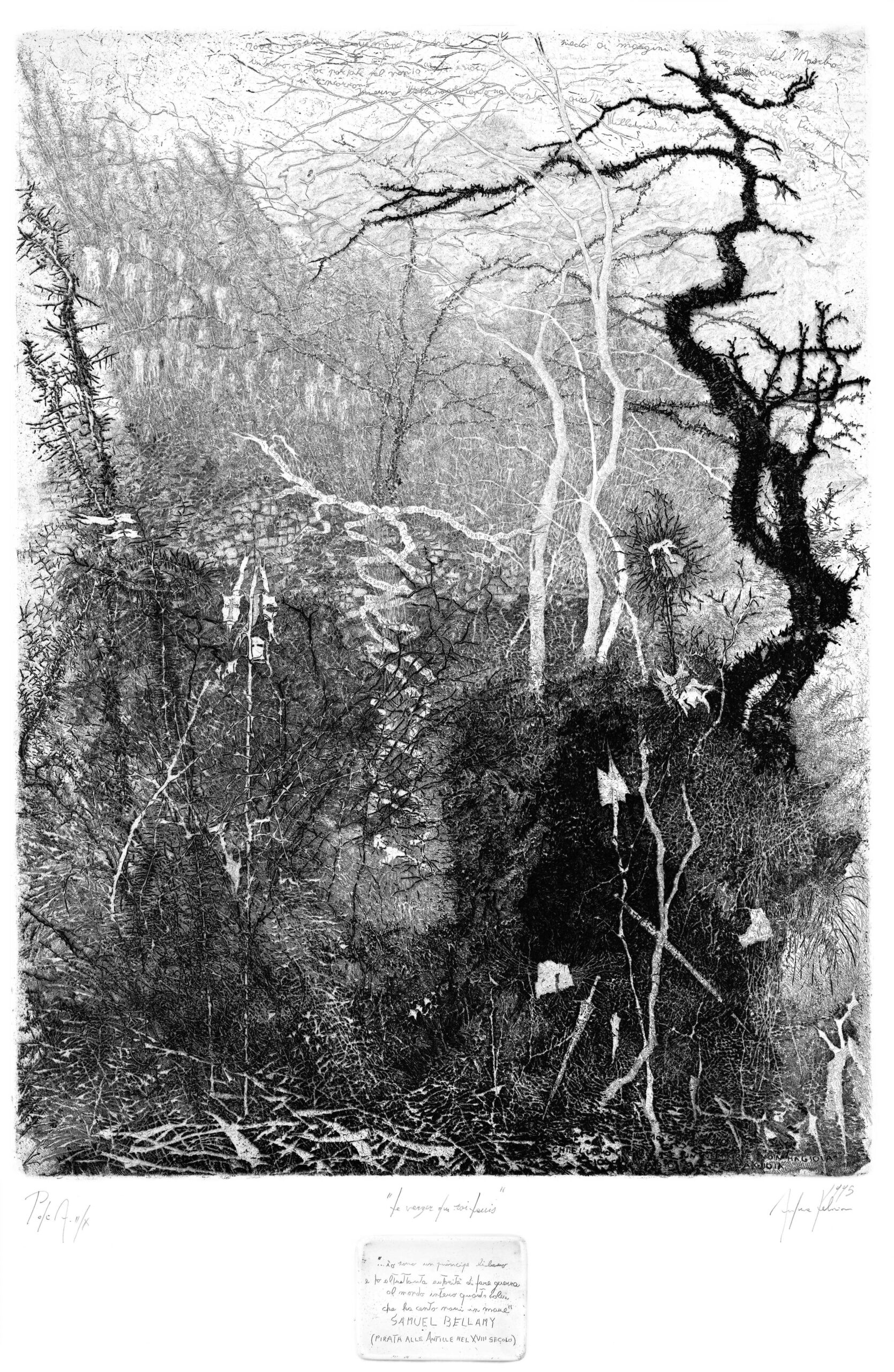
The technique is light and swirling, capable of weaving an intelligent web of restlessness that questions us from afar. Herein lies the sense tied to exoticism: the urgency to jot down streams of consciousness, starting from their details, embedded in intricate vegetation and amniotic places. It is, in reality, an inner, colorless tangle of clues and intertwining, offering protection from the surroundings and one’s own past. It is an itinerary where “lightness and the abyss” emerge, two oxymorons that restore verticality to thought, following the representation of a nature that transcends itself, radiating new allegories.
The iconographic citations become scholarly caesuras, echoes of being, where Jungian studies intertwine with the landscapes of the Grand Tour. Here, the concept of travel seems to overlap with that of a rebus, becoming a symbolic device to investigate the fringes of the unconscious, the apparitions of the imagination. Thus, one delves into a mechanism that seems to link universal networks to neuronal ones, tracing new archetypal maps.
Some of Lelario’s works resemble fossils of memory, weaves of an antiquity born to last; others act as a homage to Dürer and myth, investigating anatomies and beliefs, all with the common intent of guiding the viewer to delve into the forest of their own consciousness, studded with the glimmers of hidden harmonies.
by Alice Falsaperla


Andrea Lelario
Papers to Decipher
At the Villa
By a happy coincidence, Andrea Lelario’s studio is located in Villa Mondragone, situated between Monte Porzio Catone and Frascati. The fame of this Tuscolan villa is also linked to the fact that in 1582 it was the site of a change in the pace of time: the calendar reform promulgated by Pope Gregory XIII with the papal bull “Inter gravissimas”. The papal commission which, to fix the shift in the date of Easter, managed to modify the ancient calendar of Julius Caesar, imagined the centuries to come, the rhythms of leap years, even citing the year Two Thousand (“anno vero MM”) with visionary precision. Visionary precision is a description that perfectly suits the images produced by Andrea Lelario through the techniques of engraving and drawing. They are images that put onto the page domains of the near and the far, of the visible and the yearned for, of the celestial and the subterranean: sometimes very large, sometimes extending horizontally, often small down to a miniature, they are the result of meticulous and vast manual and conceptual work, aiming to combine the accurate scale of details with a boundless outlook.
Powers of Ten
It would require a telescopic gaze that—without the aid of magnifying glasses and without transferring the image onto an expandable screen—could sink into the tangle of the engraving’s planes, into the web of cross-hatching, and bring into focus the strings of words that accompany the scene like a paratext, or that cross the openings of the skies or emerge from ravines and thickets.
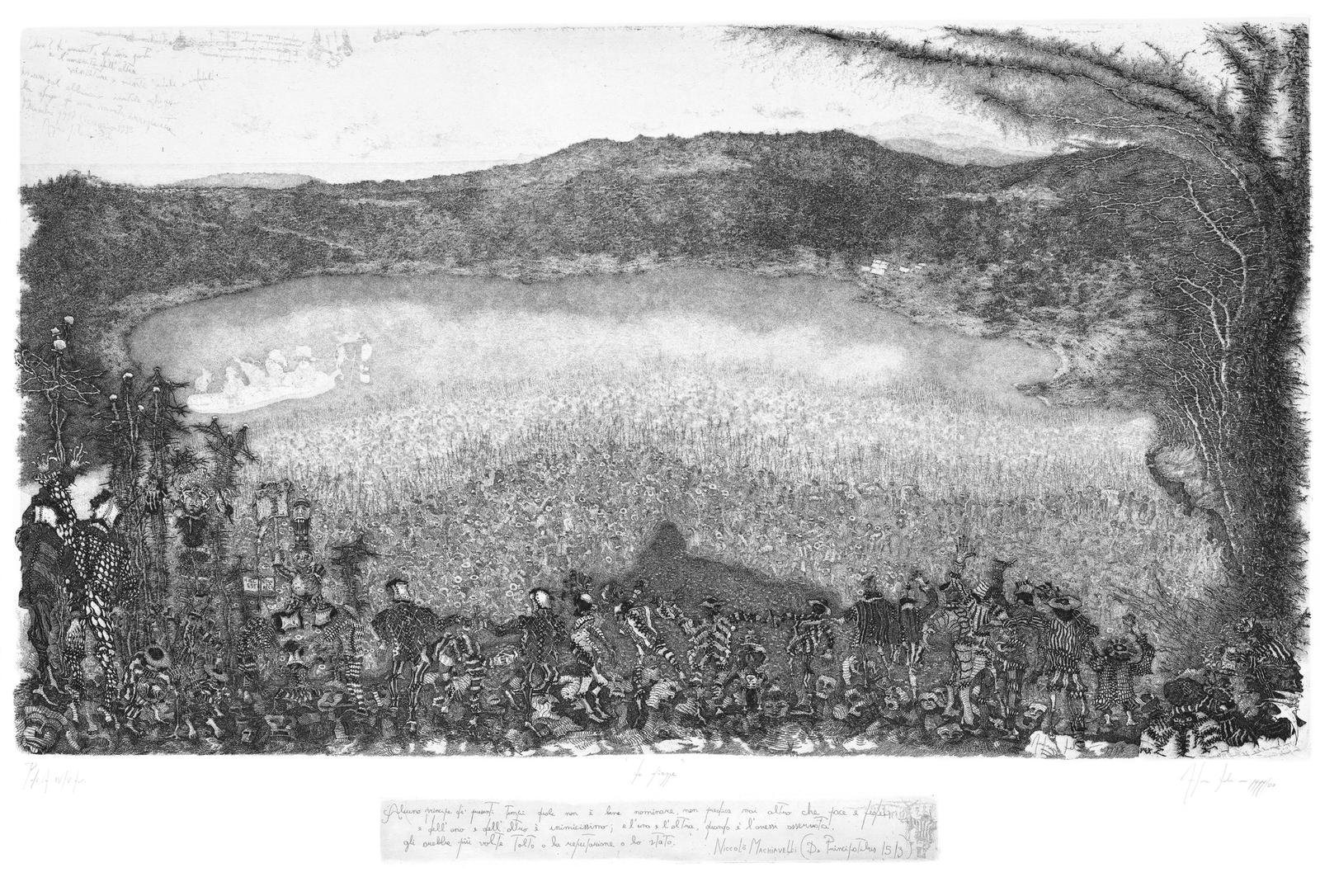
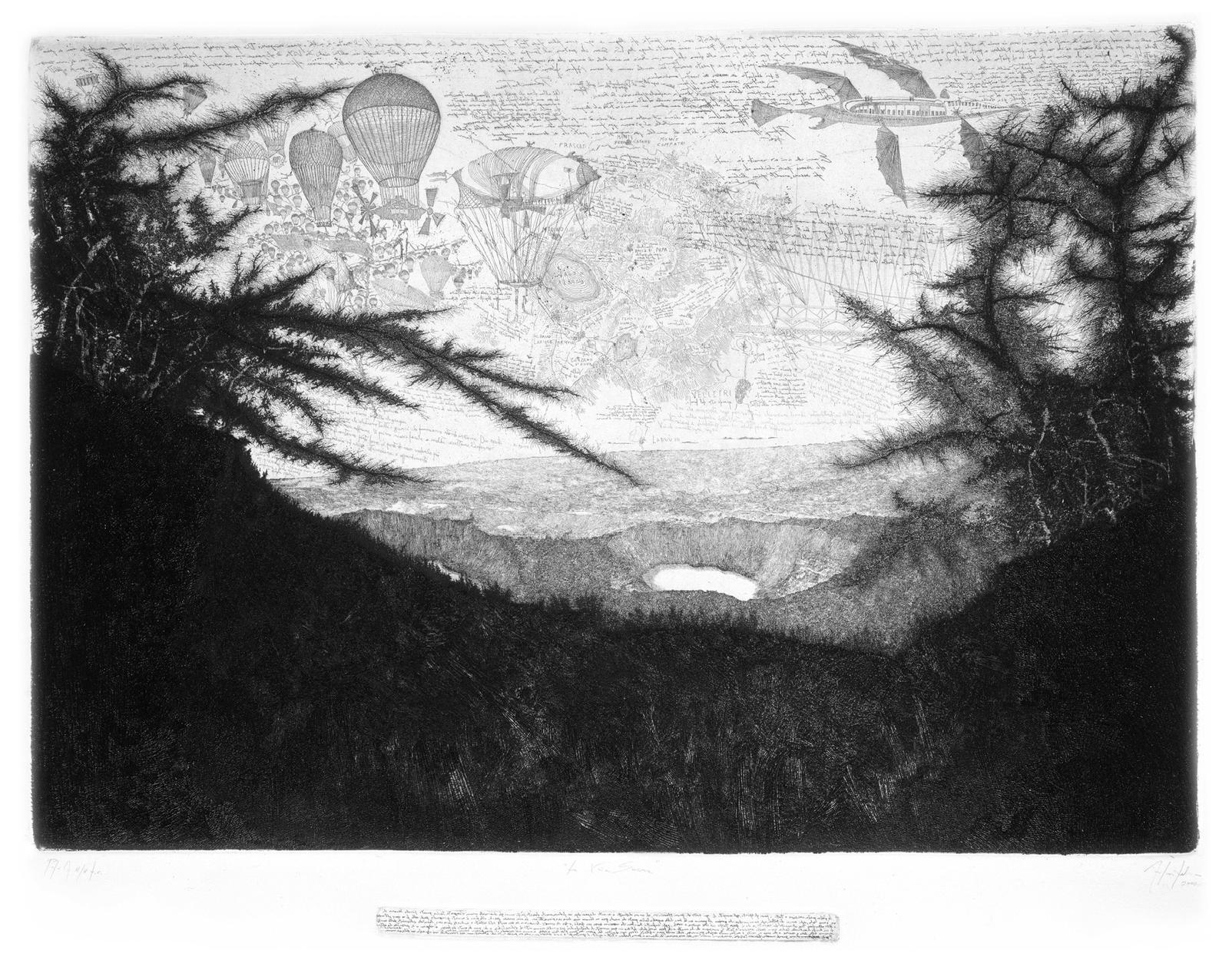
It would take the eye of Powers of Ten, the short film (1977) made by designer couple Charles and Ray Eames: starting from the human scale and following the positive and negative powers of the number 10, it reached the galaxies and the proton respectively, visualizing the patterns that emerge from a distance. But perhaps it is good that, moving from one of Andrea Lelario’s sheets to another, one is aware that so much within them remains to be seen, deciphered, read, and connected. This awareness is experienced both in the single plates (see Le Piagge, La Via Sacra, with flying inscriptions and maps blooming in the sky) and in the pages of his notebooks.
Visionaries in Black and White
In the notebooks, as the artist said in a dialogue with Silvia Scaravaggi, “anthropomorphic shapes, primal figures of imaginary animals, insect fragments, reminiscences of entomological studies, fantastic reptiles, and abstract structures thicken. I like to define this mass of artistic material as the imaginary baggage I always carry with me. That stays with me, that knocks from within and asks to come out.”
In this perfect self-analysis, one finds the protagonists of the great family of “painters of the imaginary” described by Giuliano Briganti; of the artists attracted to the “nocturnal regime” of the image defined by Gilbert Durand; of the visionaries of black and white (Meryon, Hugo, Piranesi, Goya, Dürer, Rembrandt) explored by Henri Focillon, who was himself the son of the etcher Victor-Louis (1849-1918). Without forgetting loners like Odilon Redon, who—wrote Marisa Volpi—know how to “give beauty even to the horrid, as if all the suffering of life served only for that perfection of the acid’s bite on the copper.”
by Antonella Sbrilli